
How to Reconstitute Peptides: Step-by-Step Mixing Guide
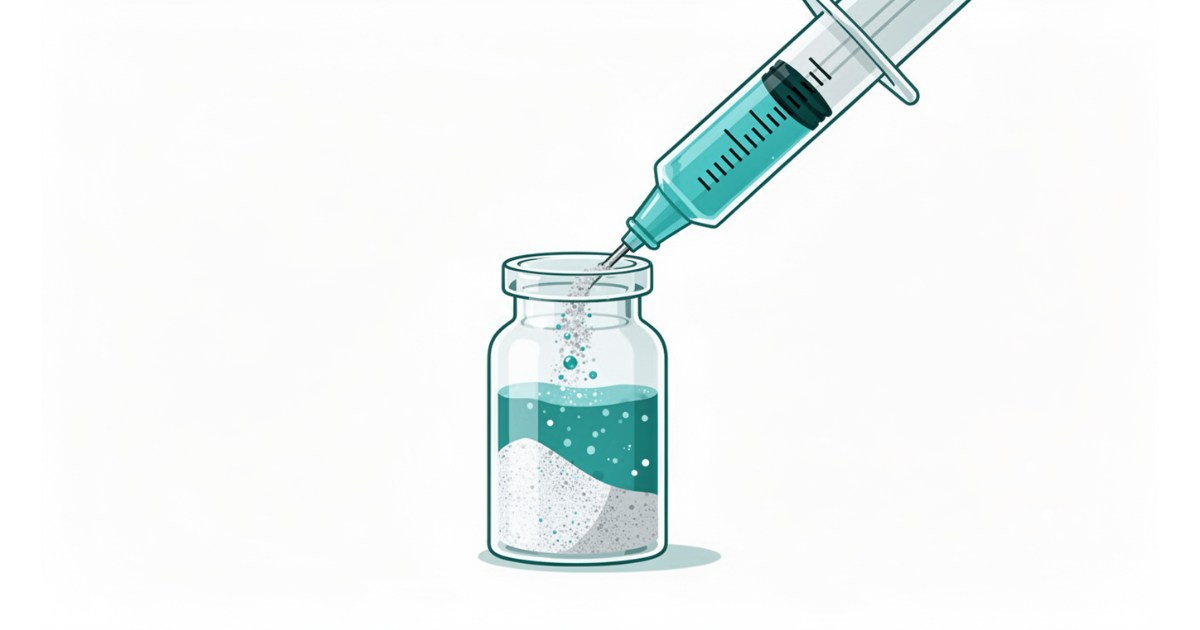
Most peptides arrive as a lyophilized (freeze-dried) powder in a small glass vial. Before you can use them, you need to reconstitute them by adding a liquid. This guide walks you through the process.
What You Need
Bacteriostatic water (BAC water). This is sterile water with 0.9% benzyl alcohol added as a preservative. It is the standard reconstitution liquid for peptides. Do not use plain sterile water, saline, or tap water. BAC water allows the reconstituted peptide to be stored and used over multiple doses (typically up to 28 days refrigerated). Plain sterile water has no preservative and must be used immediately.
A syringe for mixing. A standard 1ml insulin syringe works. Some people prefer a slightly larger syringe (3ml) for easier handling when drawing up BAC water, but it is not necessary.
Alcohol swabs. To clean vial tops before puncturing.
Step-by-Step Reconstitution
📋 Step-by-Step Reconstitution
Clean both vial tops
Swab rubber stoppers of both peptide and BAC water vials with alcohol. Let dry.
Draw up BAC water
Decide amount (see dosing math below). Draw into syringe. Common: 1ml or 2ml.
Add water to peptide vial
Aim down the glass wall — let it trickle onto the powder. Do NOT squirt directly.
Let it dissolve
Do NOT shake. Gently swirl or let sit 5-30 minutes. Solution should become clear.
Store correctly
Refrigerate 2-8°C, keep upright. Write the date on the vial. Use within 28 days.
💡 Technique tip: Aim the stream of BAC water gently down the inside wall of the vial. Let it trickle down onto the powder. Do NOT squirt directly onto the powder — this can damage the peptide.
The Dosing Math (Simple Version)
This is where people get confused, but it is just basic division.
The formula: You need to know two things: how much peptide is in the vial (in mg or mcg, check the label), and how much BAC water you added.
If your vial contains 5mg of peptide and you add 2ml of BAC water, then every 1ml of solution contains 2.5mg of peptide. Every 0.1ml (10 units on an insulin syringe) contains 250mcg.
| Vial Size | BAC Water | Per 0.1ml (10 units) |
|---|---|---|
| 5mg | 1ml | 500mcg |
| 5mg | 2ml | 250mcg |
| 5mg | 2.5ml | 200mcg |
| 10mg | 1ml | 1000mcg (1mg) |
| 10mg | 2ml | 500mcg |
| 10mg | 5ml | 200mcg |
Adding more water makes each unit on the syringe a smaller dose, which gives you more precision. If you need small doses (like 100-200mcg), adding more water is better so you are not trying to measure tiny fractions of a syringe unit.
Precision Tip
Common Mistakes
Squirting water directly onto the powder. Aim down the glass wall. Let it trickle.
Shaking the vial. Peptides are fragile. Vigorous shaking can denature (destroy) them. Gentle swirl only.
Using plain sterile water instead of BAC water. If you use sterile water, you must use the entire vial in one session. BAC water's preservative allows multi-dose use.
Forgetting to refrigerate. Once reconstituted, peptides degrade at room temperature. Fridge immediately.
Not tracking the date. Write the date on the vial. Discard after 28 days.
Get the Peptide Starter Guide (free PDF)
Evidence-based primer covering the top 10 peptides, dosing, and safety. No spam.